
By George E. Emanuel
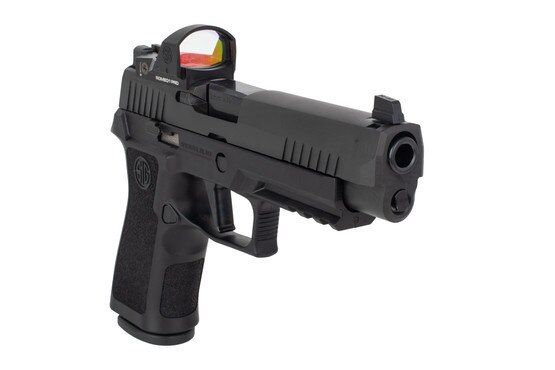
“Is Your Pistol Dot Too Small”
By George E. Emanuel
What if I could show you what you really need on a defensive pistol, made it easier to use, faster to acquire and shaved time off your draw to first shot on target?
Let’s have an honest conversation — shooter to shooter. There’s a belief floating around out there that a smaller red dot on your pistol equals better accuracy. I’m here to tell you plainly: in a defensive scenario, that small dot is costing you time — and time and acceptable accuracy are everything.
You’ve probably heard of the “Rule of Threes”: three yards, three shots, three seconds. That’s how fast nd close aa self-defense shooting typically unfolds. It’s an old wives’ tale, not a rule set in stone, but it’s grounded in FBI data. Even if those stats are incomplete — and they are — the principle stands. Encounters are short. And brutal. Increase the distance to ten yards, and you are at least approaching the truth in 90% of defensive use of a pistol. (In fact, if we consider a gun being seen by an attacker but not actually fired, defensive use of a firearm skyrockets to 500,000 to 3,000,000 usages per year. The wide margin here is that the upper end can only be reasonably estimated, as no entity is maintaining data on these usages, but I digress.
Now, let us begin by first looking at the real-world accuracy of most handguns. Take, for instance, a Glock 19. Locked in a Ransom Rest at 25 yards — a setup designed to remove human error — you’re looking at a 2”–2.5” group. That’s mechanical accuracy. If you’re a newer shooter, handheld, you might get a 10” group at that distance with practice. A seasoned hand might cut it down to 4”, at a reasonable rate of fire for defensive purposes.
All of that’s on a square range with no pressure, no stress, and no incoming threat. And you get as many do-overs as you like.
However, this ignores the fact that the only shots that are really going to count are the first one, two, three, four, or five that you fire. They are cold shots. These are the ones which will stop the attack or lose the encounter. When was the last time you heard of an attacker giving a defender time to “warm up” before the scoring started?
Suffice it to say, at ten yards, a four-inch COM group of 3-5 rounds delivered in three seconds will at least give you a chance. To you magazine dumpers reading this, I leave you with the last words of the famous former military expert General Disaster, “I guess I didn’t miss fast enough.”
So, can we leave all the ifs, ands, and buts in the holster and talk honestly about real-world considerations that might improve your chance of survival?
We will discuss red dots, and I will be candid with you about them.
They are not panacea!
I love them, especially for teaching new shooters, as they leverage natural human instincts and avoid artificial conventions that only create obstacles to success. Doubt me? Ever take a young kid fishing for the first time and catch no fish? How did you do the second time you took him?
At ten yards and beyond, red dots absolutely have value, but that value diminishes as the distance to the target closes. Three yards, think about it! You could have the attacker reach out and grab your gun before you can draw it and fire from retention. This is why we teach you to begin backing up as soon as your hand moves toward the gun. We are looking to increase the distance. Distance Equals Time!
At five yards, if you are looking for your dot, you are likely dead already. In fact, the closest you could reliably draw and fire any sighted shot would likely be ten yards.
Inside seven yards, we should really be point-shooting. We often see this employed; it is our instinct, especially when we experience a massive adrenaline surge and exposure to a deadly situation for the first time. But not many of us are instructed in performing this way, why? I don’t know. Perhaps the falling from favor of the art of using “common sense” Or the lawyer pointing out to the jury that you didn’t use your sights? If he knew, and he may well know, that there is a technique called “unsighted fire” which is intended for circumstances where speed is of the essence, and distance is such that sights may not be required for survival.
Let’s look at Red Dot Sights.
A 2 MOA (Minute of Angle) red dot covers about ½ inch at 25 yards. That’s razor thin. Why? One MOA equals one inch at 100 yards. So do the math: 2 MOA = ½ inch at 25. It’s precise —too precise for defensive purposes.
Ask yourself this question: if your “defensive accuracy zone” is roughly an 8” circle (center of mass), why are you using a dot and forcing yourself to aim with surgical precision? That tiny dot may help on the bench, zeroing for “Bullseye” shooting, but in a real-world encounter? It slows you down and may land you in a casket.
And let’s be clear: I’m not calling you foolish for choosing a small dot. I’m saying you’ve likely been misled. There’s a lot of bad information out there, and most of it comes from folks who don’t know what they don’t know. I’m here to fill those gaps — not just with facts, but with context. And if you are one of those who still cannot look at the target and reliably see the dot as you raise the gun into your line of sight, without the head bobbing dance of the shooter soon to be eliminated from the fight, it’s not going to be your best day. (Is it not possible that, as red dots were first introduced for rifles, the accuracy factor required for them was carried over to pistols as an oversight?)
Defensive shooting is about one thing above all: the balance between speed and accuracy. Sacrifice either, and you risk not making it home. Speed and Accuracy, Speed and Accuracy, Speed and Accuracy. Never Speed OR Accuracy!
With the advent of “Stand Your Ground” laws, here’s another angle that too few talk about just because you might legally take a shot at 25+ yards doesn’t mean you should. In many cases, the smart move — the legally and morally defensible move — is to exit. The law might allow you to defend yourself, but it doesn’t give you a blank check. If the attacker at that distance is wielding a knife or other “contact: weapon, use your head. That is not a “deadly force situation,” and if you are in doubt that I am correct, ask an attorney who specializes in self-defense law. It might save your future.
Now, back to that dot.
Let’s break it down at potential defensive distances:
- At 25 yards: 2 MOA = ½ inch
- At 15 yards: ~⅓ inch
- At 5 yards: ~⅒ inch
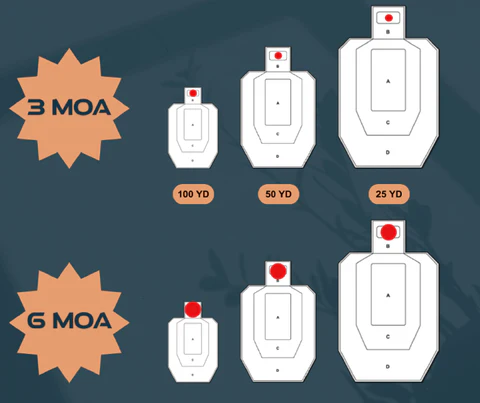
One of my most significant issues with how shooting is taught today is that many instructors unintentionally lean toward bullseye fundamentals. Great for target shooting — not great when someone’s charging you with a knife. Defensive students need to move fast and hit reliably. And that’s not what a tiny, dim dot trains you to do. Turn your dot down until you can just see it? This is to prevent blooming or distortion of the dot’s appearance, which can make it appear larger than it is. I say turn the damn thing up, it’s too small to begin with!
Think about this:
Imagine that an 8” circle is on an attacker’s chest. Now picture it again with a 2 MOA dot versus a 6- or 8-MOA dot. Ask yourself: ( using the area covered by the two MOA dots from above, multiply times three for a six-moa dot, or four for an eight-moa dot. Now imagine putting that bigger dot inside the eight-inch COM of your attacker.
- Which dot is faster to find in the window?
- Which stands out more on the target?
- Which one are you more likely to overthink?
- Which helps you press the trigger now, not later?
Exactly. The larger dot wins across the board.
(At least one manufacturer offers a 32 MOA ghost ring. Or, 3.2” at 10 yards, and you are shooting at an eight-inch center of mass?) This may be a bit too large, but it can be used to help acquire the dot for visually impaired shooters.
New shooters often struggle to find the dot quickly. A bigger, brighter dot means faster acquisition, especially under stress. Yes, you can train to improve that—and you should—but the tool should work with you, not against you.
Here’s another point: being “more accurate” than necessary isn’t a virtue — it’s a liability. Defensive shooting isn’t about surgical precision; it’s about effective hits that stop the threat.
Ask any trauma medic. A 1” group on the same wound track might be impressive on the range, but in the real world, multiple hits spread across vital areas cause faster blood loss — and speedier incapacitation. A tight group might look good, but it’s not always the best outcome—time matters. So do Wound channels. Incapacitation is affected by a rapid loss of blood pressure
And that extra half-second you spent refining your sight picture? That’s the time your attacker used to close the distance or land a shot of their own.
A larger dot — say 6, 8, or larger MOA — can be a game-changer at defensive distances. It’s fast, visible, and effective. And before someone chimes in with, “Yeah, but it’s not good for 50-yard shots,” let me stop you right there. We’re talking about defensive distances. Twenty-five yards and under. Beyond that? You’re not in a gunfight — you’re in a legal minefield.
And before you start postulating that defense of others may well require longer-distance accuracy, touché, and slow down to be more deliberate! Speed and Accuracy are still the guiding principles.
On the medical side, if you’re dealing with astigmatism, larger dots are even more forgiving. Choose what works for your eyes. Red or green? Up to you.
So next time you’re shopping for a red dot, think about what you really need to do. A bigger dot will likely serve you better, make you faster, and keep you safer. And odds are, it’ll cost less than that ultra-precise, ultra-small option everyone on the forums is raving about.
Think Critically, Train smart, Shoot with Speed and Accuracy, Live longer.