
By George E. Emanuel
I would like to think that gun owners are reasonably intelligent people, but alas, some of you are not, sometimes, and it shows. Unfortunately your words reflect poorly on the rest of us, so this is for you!
Quit calling your firearm a weapon!!!
As a veteran of both the US Army and the US Navy I had a very difficult time making the transition from “weapon” to “gun” or “firearm”. I freely admit it.
The military has way of drumming into you that these tools are in fact weapons. And in the context of the military they are absolutely correct in accurately describing guns in this manner.
So why George do you have your panties in such a twist over a simple word. Well let me be clear. Less than five percent of the population of this Country have ever served in the armed forces. This paltry number is cause for an editorial in and of itself, but, that is for another day. I don’t care why you weren’t in the service, in fact, I am thankful that you weren’t. It can be a nasty business when you are called upon to use your weapon.
You see the military jargon is correct in referring to your firearm as a weapon because they kill people with guns. Do you? Now they don’t do it because they want to, they do it because that is the nature of the job. So, when they call it a weapon, that is exactly what it is in their hands.
Do you hunt, target shoot, or enjoy plinking? Most gun owners do. Are you taking another human life? I hope not!
There is such a thing as a weapon, but it is not the rifle, the pistol or the shotgun in the hands of civilians. Rather what makes it a weapon is the evil that resides in some of the darker members of our species.
There is a distinction between using a firearm as a weapon to kill an enemy and murdering each other. Even the Bible makes a distinction between killing and murder. The Ten Commandments are most frequently quoted as “Thou shall not kill” but, the actual meaning is you should not commit murder. Although the distinction is lost on some of us.
Put another way, killing is taking another life to protect or preserve our own, whether individually or collectively, as in the military. This may also be done in self-defense, or to preserve the safety of others. We are not using it offensively as in the military, we have no enemy to pursue, as they do.
It is not done to avenge some wrong, or appropriate riches from another. It is not done for fame or notoriety. When people take a life for such reasons we call that murder!
We could go through a litany of items that have been used by man to kill others. A hammer, a knife, a golf club, a rope, a rock and on and on ad nauseum.
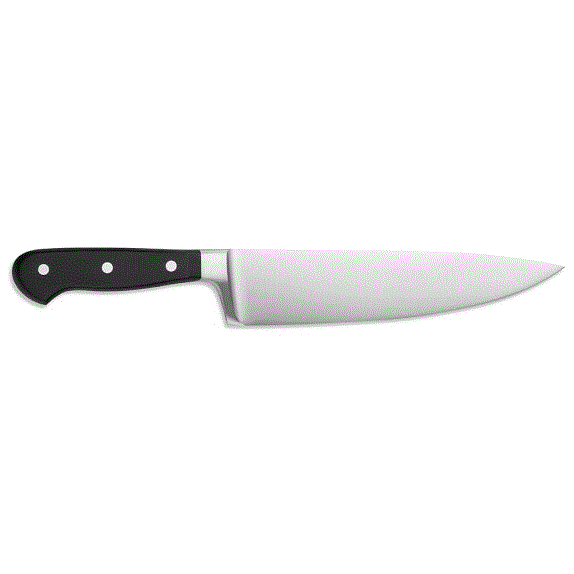
The inanimate object is not a weapon, or even a tool. Your intent in its use is what determines which it will ultimately become. The choice of the object has nothing to do with killing or murder until someone interacts with it to cause it to become one.
So, I ask again, do you intend to kill someone? If you do please get help from appropriate medical professionals. I say this in all seriousness. Do not do this to others, or yourself. Get help!
Hopefully we have established when an object becomes a weapon and have determined that only a very small number of us would ever think of using an object to murder another.
So, what’s the point?
Sandy Hook, Columbine, VA Tech, the Pulse Night Club, the Aurora Theater, the rally for Gabbie Giffords, John F Kennedy, Robert Kennedy, Martin Luther King, Steve Scalise, and police on the beat are the point, along with too many others.
After each mass shooting or assassination attempt, successful or not, a certain portion of the population rolls out the anti-gun wagon and tries once again to take away an inanimate object from you and me. It happens like the sunrise and sunset.
They will opine about assault weapons, high capacity magazines and how these should be banned.
Really? Ban the object?
We have learned that of all the recent mass shooting it is unlikely any of them would have happened without the failure of government at many levels to take the individuals who committed those shooting off of the street and out of our society before they acted.
Do we need to add to already inflamed emotions by calling our firearm a weapon? That sort of bravado plays right into their hands. It will only give them more ammunition to use to take away all of our guns.
As I said in the beginning, I am a military veteran, and I cringe every time I hear one of you Rambo’s calling firearms weapons. You will not earn my respect in so doing for you are demonstrating an attitude which I believe is stupid and is probably an attempt at compensation for some missing quality in your life. Or to put as R Lee Ermy probably would have, “You’re an idiot”
I am glad we had this little talk. From now on I hope you will catch yourself when you say the wrong word and begin to call firearms by their proper names. This will not only get my attention, but, my respect as well.
Be a responsibly armed American, learn our language and join us in our never-ending devotion to our Constitution and Our great Country!
Welcome aboard, you now have all you need to know to accomplish the conversion!
A gunfight is not a place for oops!